Monday, November 27, 2017

Recife

Next, it was on to Recife - Brazil's fourth largest city.
Recife's nickname is "Venice of Brazil" because of its many bridges and waterways.
A major port on the Atlantic Ocean, its name is derived from the coral reefs that are dotted along the shores.
 It just so happens that our Temple Recorder/Bishop is from Recife, so we were fortunate to have our own personal guide! Cleto and Ana Marcia Oliveira were great! 


We spent our first day at the beach.
 Porto de Galinhas is one of the most famous beaches in Brazil. It means "Port of Chickens" in Portuguese. In the late 19th century, "black ships" transported slaves from Africa to Brazil to work in the sugarcane farms around Recife. This, of course, was prohibited, so in order to get around that, when a ship arrived in town, the word spread as "there are new chickens in the port", hence, the place gained its name Porto de Galinhas. 


 There are a lot of vendors on the beach!

 Fish and shrimp for us!


But BEWARE! Recife is known as having one of the top 10 shark infested beaches in the world (according to the Discovery Channel). You'll find many signs along the water's edge warning about the dangers of swimming. 
This kind of keeps the surfers away, as well!


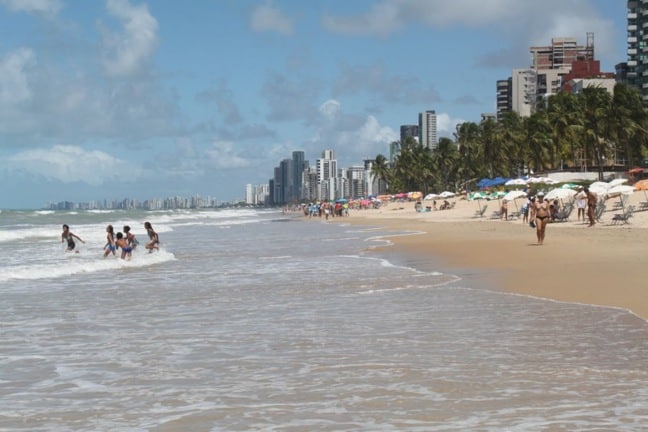
Kids playing on Boa Viagem Beach

The Recife Brazil Temple was the second temple built in Brazil
Before the Recife Brazil Temple was constructed, the closest temple for members in Recife was the São Paulo Temple which was a fifty-hour drive away. The temple was dedicated December 15, 2000 by Gordon B. Hinckley. I think they said that it was a mango farm originally and many of those trees remain today. There are also towering royal palms at the formal entrance to the temple and, of course, beautiful gardens of flowers everywhere.


Recife has some great places to eat. The Oliveiras took us to one specializing in food of the northeast. 


There was so much to take in. And we couldn't have asked for better tour guides!


Moving right along...
Next...
Manaus.

Sunday, November 26, 2017

Spring Break - Or, When in Brazil...Rio

We've just completed our two week spring cleaning break at the the temple. 
Not wanting to hang around Curitiba during this time, we planned a little get-away. 
Our adventure took us to 
Rio de Janeiro→Brasilia→Recife→Manaus→São Paulo→back to Curitiba. 
Then it was on to Foz do Iguaçu→São Paulo→Curitiba→back to São Paulo→then back to Curitiba→and finally Home Again for Real!
We chalked up over 7,300 air miles in our 14 days.


Sooooo much to cover!


Let's start with destination #1.

Rio de Janeiro

Rio attracts over 2.8 million tourists a year. We were just 4 of them! 
Rio is also known as having the "bluest sky" in the whole wide world! (The statement seems bit audacious, but it’s actually based on a survey done in 2006 by a TV researcher who travelled around the globe in search of the world's bluest sky.) 
This I didn't know...Rio has a nickname...Cidade Maravilhosa or 'the marvelous city'.

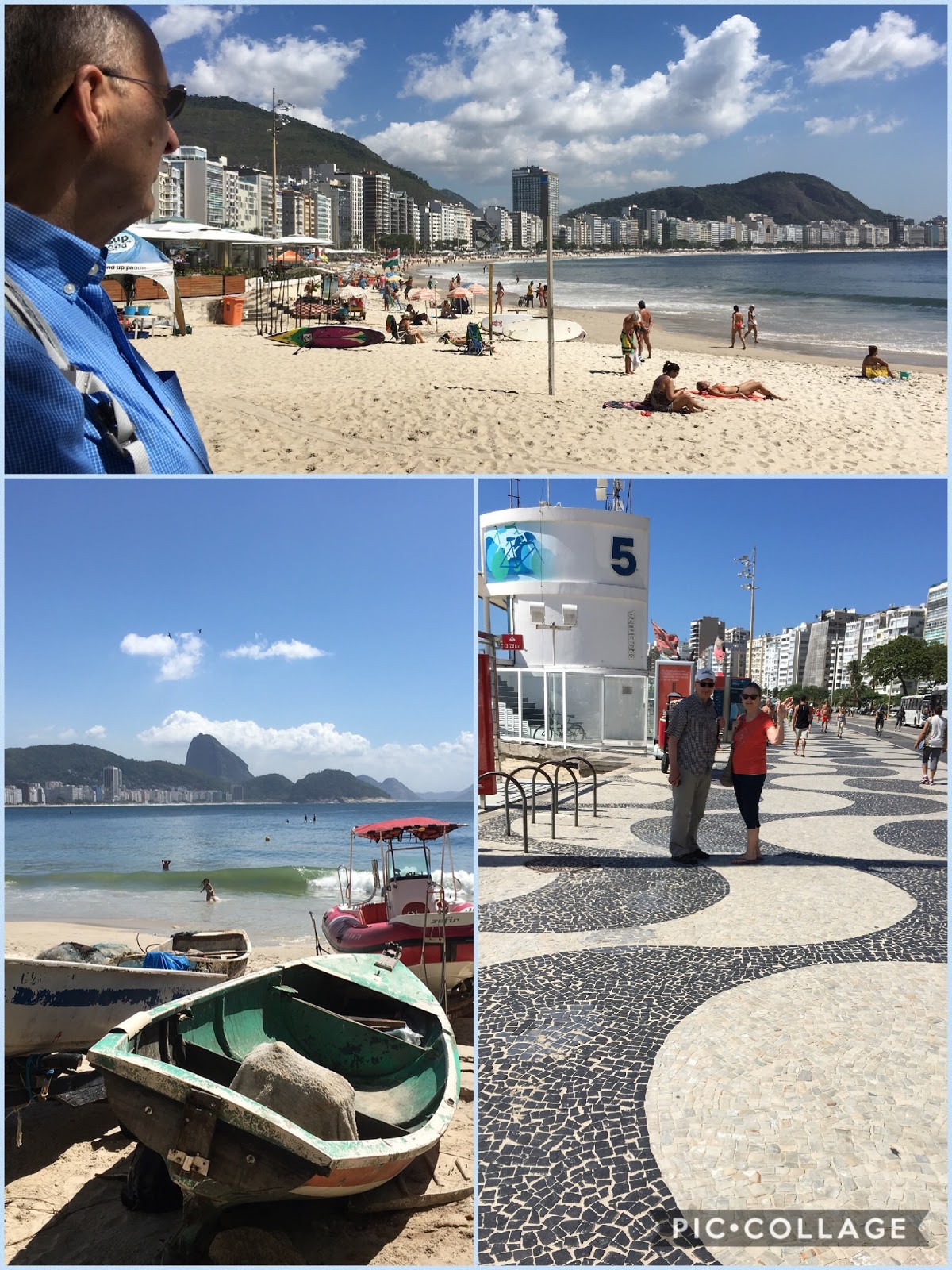
Rio de Janeiro has several gorgeous beaches, including world famous Copacabana and Ipanema. The beauty of Ipanema even inspired a popular bossa nova hit, The Girl from Ipanema.


The wavy black and white patterned sidewalks that run the 4-km-long distance of the promenade were completed in 1970. The black and white waves represent the White Europeans and the Black African slaves, whose history is intertwined in Brazil. Within the black and white lines, you will find pockets of red. This represents the indigenous peoples of Brazil.


Next time you’re strolling along the beach in Copacabana, look down and around you. Find those pockets of color in the sidewalk mosaic, and think about the history embedded there.

The Girl from...↓


The Christ the Redeemer statue (Cristo Redentor) is located on Corcovado mountain in Tijuca forest, overlooking the city of Rio de Janeiro. It is the largest Art Deco statue in the world. It stands 98 feet tall, not including the pedestal. The outstretched arms on the Christ the Redeemer statue measure 28 feet wide. The statue took 9 years to construct and was completed in 1931. Even though it is struck by lightning a couple times a year, it lives on strong, watching over the citizens of the Marvelous City and stands as an enduring symbol of Brazilian Christianity. 


The city’s famous Sugar Loaf Mountain (Pão de Açucar) is almost 400 meters high and supposedly resembles a heap of sugar. It has over 250 climbing routes, making it one of the world’s most popular urban climbing areas.


Favelas are Brazilian slums. They are often erected hastily and haphazardly to fulfill the necessity for immediate housing. The first recorded favela is believed to have been built in the late 1800s.There are more than 1,000 slums, or favelas, in Rio – and almost one fourth of Cariocas (locals) live in them. It was there, in the favelas, that former African slaves and their descendants first created the music style we now know as samba.
Nowadays, most of the city’s renowned samba schools that compete in the world famous parade every carnival are located in favelas, or close by.

(We didn't go in them - we just drove by them.)


We only had one day in Rio. We loved what we were able to see. We had a great taxi driver who took us all over. The new temple is being built quite a ways outside the main city - too far to visit.

Next stop-
Recife

...but that will have to wait until tomorrow.

Tuesday, October 31, 2017

A Rainy Day and Monday

Curitiba gets about 55.4 inches of rainfall a year. That's about 4.6 inches a month.
The Rule-of-Thumb seems to be:
Never go anywhere without an umbrella.
Never let a little rain stop you.


So, doing just that, we bought tickets for the Sierra Verde Express last week - realizing that we could be doing this during rain or shine. It had rained all day Sunday and throughout the night, but when we woke up on Monday...
...it was just wet!

YaHoo!
This is the train ride we took with the Browns back in January -  through the Atlantic Rainforest and into the historic towns of Morretes and Antonina. (This time, however, we opted for the English speaking guide.) 
(It started out a little damp and chilly.)

Weather rain, clouds, or sunshine, the scenery is beautiful. And, because the train goes soooo slow, you can even stick your head out the window for a better photo.


For lunch it was the typical dish of the region - barreado - served with rice, cassava flour and sliced bananas on top. If you're not a fan of this "stew", then fish and shrimp are served as accompaniments.

The coast is much warmer than Curitiba, so we were able to shed some of our outerwear.😀 
Morretes↑  Antonina↓

So the lesson to be learned is that Rain or Shine you can still have a good time!
(Especially if you do it with good friends like Wayne and Dianne!)


Tuesday, October 17, 2017

Feira do Largo da Ordem


This week took us to the 
Feira do Largo do Ordem.
Known to be one of the largest street fairs in Latin America, this is a very beloved weekend attraction for tourists and locals alike.  
Every Sunday, come rain or shine, there it is! (I know, the fact that it is held on Sunday is very unfortunate.) 
This is an enormous outdoor market where you can find a little of everything: paintings, carvings, embroidery, knitting, jewelry, baskets, slippers, handbags, flowers, tablecloths, bonsai, rugs, dolls, antiques, and many “et ceteras”. All this among the colorful houses and buildings and historic churches.
So...after church, feeling a little guilt, we hopped on the bus and headed to Largo da Ordem.
One must be careful not to unleash the obsessive-compulsive shopping disorder. Everything is so cheap, so easy, so quick, and so pretty.
We seemed to be a bit overdressed for the event. 

Besides the sites, there were the sounds. 
Yes, Elvis is alive and well in Brazil!


Like any good outdoor crafts fair that is worth visiting, the Largo da Ordem street market has a large “food court”.  
I'm not exactly sure what we ate, but it was good.


In this section of town you will also find the Curitiba Mosque.
According to the Islamic culture, the mosque faces the northeast toward the holy city of Mecca. Visitors can go inside if they take off their shoes at the entrance. Women are offered a headscarf which must be worn inside the mosque. The floor is covered with original Persian carpets.
Since we didn't buy one of those books, that's about all the information I can give you.


We found out yesterday that the Wernecks will be returning to their home to take care of some unresolved health issues. We will miss them and we wish them well. 
We were able to enjoy one last chá with them. 


P.S. If anyone asks, we are still very busy working in the temple. 😊


Tuesday, October 10, 2017

All their bags are packed. They're ready to go!


Change is good. Right? 
This week we say good-bye to
 the Parrelas
 (Adalton & Delgia) 

They will be returning home to Florianopolis on Thursday. We will miss them a lot. We will miss their enthusiasm, stories, wheelings and dealings, humor, and dedication to the Lord.


Friday was our last "triple" date night. We let Adalton pick the place since we were also celebrating his birthday.
Since he's Brazilian and loves to eat, guess where we ended up?


He was a very happy birthday boy!!


And now for your
Word of the Week
Jabuticaba
(jaw-boo-chi-kaw-buh)
(Also known as the Brazilian Grape Tree) 
Found in Southern Brazil, this has got to be one of the weirdest trees in the world. The grape-like fruit grows directly on its trunk instead of on its branches. The fruit looks like big purple grapes. The "natives" think that Jubuticaba fruit is delicious! 


The fruit does taste a little bit like a grape. And just like a grape, all you do is put one in your mouth and bite down to pop it open. The soft pulp is sweet and delicious. If you chew the skin you will find it is quite acidic. (I can vouch for that!) Many people find the skin a bit tough and spit it out along with the seeds. (A very smart idea!)
I am really glad I got to try this unusual fruit, but I probably won't miss it that much when I go home.